
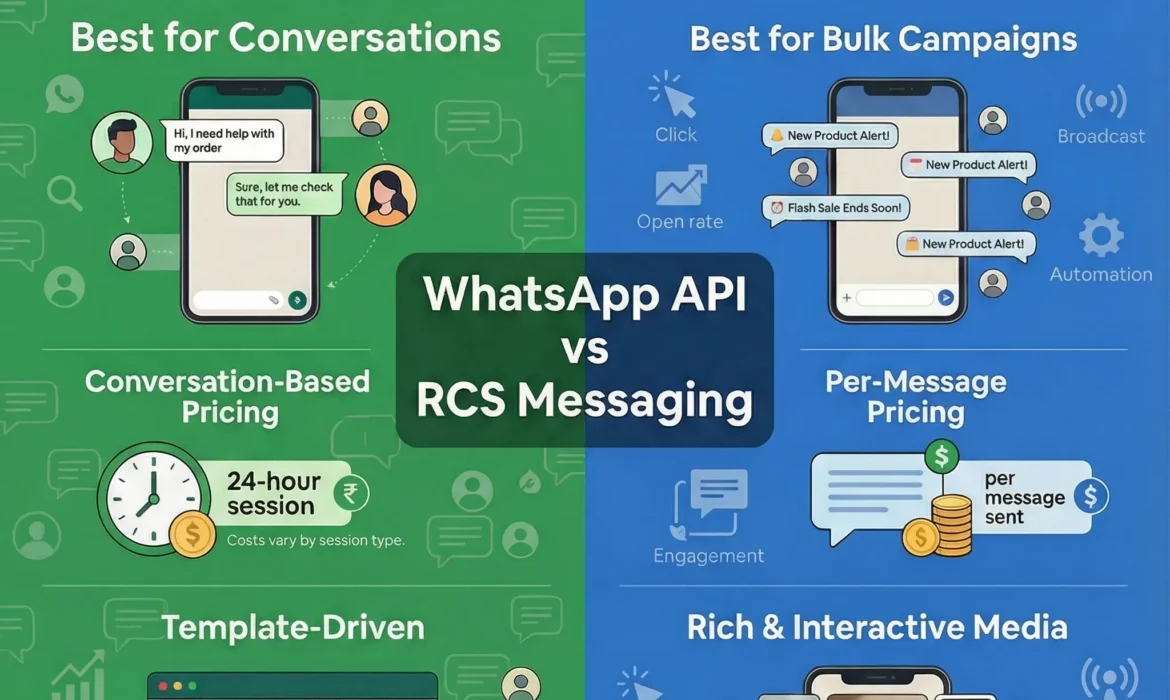
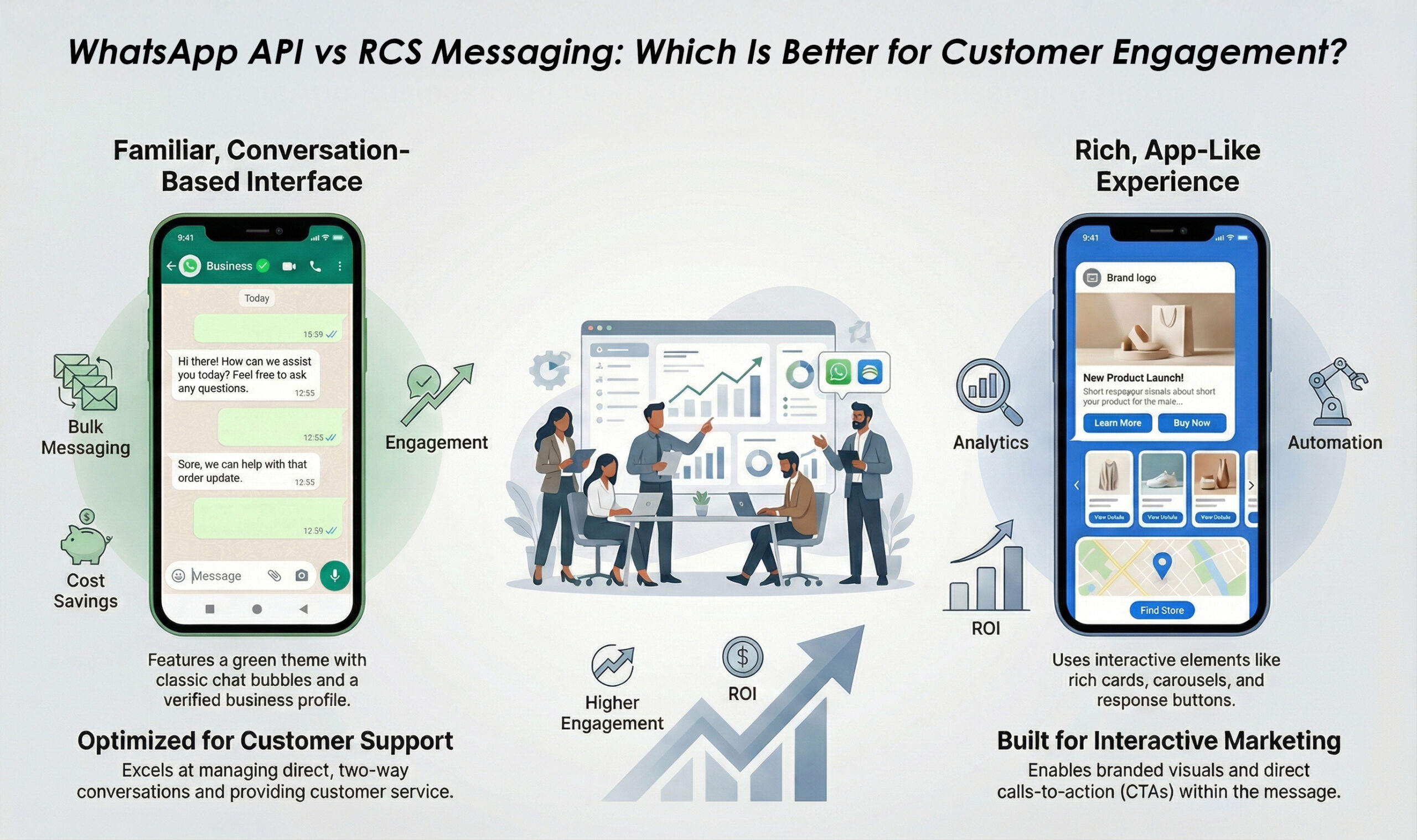
In today’s digital-first world, customers no longer respond effectively to emails or traditional SMS. Businesses need communication channels that are instant, interactive, and personalized. This is why modern messaging platforms like WhatsApp Business API and RCS business messaging have become critical tools for customer engagement.
For Indian SMBs and startups, customer engagement is not just about sending messages. It’s about:
- Ensuring messages are delivered
- Getting customers to open and read
- Encouraging them to take action (reply, click, or purchase)
Both WhatsApp API and RCS Messaging are powerful solutions, but they differ significantly in terms of cost, reach, scalability, and use cases. This blog compares WhatsApp API vs RCS Messaging in detail to help businesses—especially cost-conscious Indian SMBs—choose the right messaging channel for their goals.
Whether you want personalized conversations on WhatsApp or want to reach a large audience through Bulk RCS Messaging, this guide will help you make an informed decision.
What Is WhatsApp Business API? (A Simple Explanation for Businesses)
WhatsApp Business API is an official solution provided by Meta (WhatsApp) for medium and large businesses that want to communicate with customers at scale. It is very different from the regular WhatsApp Business App.
WhatsApp Business App vs WhatsApp API
- WhatsApp Business App → Designed for small businesses, manual chatting
- WhatsApp Business API → Built for automation, multiple agents, and system integrations
Using WhatsApp Business API, businesses can:
- Send notifications, alerts, and promotional messages
- Enable automated replies, chatbots, and live agent support
- Allow multiple team members to manage conversations from one WhatsApp number
WhatsApp API Account: How It Works
To use WhatsApp Business API, businesses must create a WhatsApp API account through an official WhatsApp solution provider.
The process usually involves:
- Business verification via Meta (Facebook Business Manager)
- Phone number registration (new or existing)
- Approval for WhatsApp API access
Businesses cannot directly activate the API from WhatsApp. This is why companies typically choose official providers like LeminAi for faster and smoother onboarding.
WhatsApp API Integration: What Can Businesses Do?
Once WhatsApp API integration is completed, businesses can handle a wide range of customer communication use cases, such as:
- Order confirmations and delivery updates
- Appointment reminders
- Customer support conversations
- Sales and lead follow-ups
- Automated FAQs using chatbots
WhatsApp API can also be integrated with CRMs, websites, apps, and eCommerce platforms, depending on the provider’s capabilities.
WhatsApp Business API Setup: Overview
The WhatsApp business API setup process generally includes the following steps:
- Submitting business details for verification
- Registering a phone number
- Getting WhatsApp API approval
- Creating and approving message templates
- Accessing the messaging dashboard and agent panel
This setup process can be technical and time-consuming if not handled by the right provider, especially for first-time users.
What Is RCS Messaging? (The Future of Business Messaging)
RCS (Rich Communication Services) is the next generation of SMS designed to make business messaging more interactive, visual, and engaging. For businesses, RCS Business Messaging (RBM) enables branded, interactive conversations directly within supported messaging apps. It upgrades traditional SMS into a rich, app-like messaging experience, without requiring customers to install any additional app.
Unlike WhatsApp, RCS works directly inside the default messaging app on a user’s phone (such as Google Messages). This makes RCS business messaging extremely powerful for reaching a large audience, especially in markets like India where Android smartphones dominate.
In simple terms, RCS combines the reach of SMS with the rich features of WhatsApp
How RCS Business Messaging Works?
With RCS messaging API, businesses can send branded and interactive messages that include:
- High-quality images and videos
- Carousels (multiple cards in one message)
- Quick reply buttons
- Call-to-action buttons like Buy Now, Track Order, or Call Us
- Read receipts and delivery reports
All of this happens inside the customer’s native messaging inbox, which feels familiar and trustworthy.
Unlike WhatsApp, customers do not need to opt in through an app or download anything. If their device and network support RCS, they automatically receive rich messages.
RCS Business Messaging vs Traditional SMS
Traditional SMS is limited to plain text and links. RCS business messaging removes these limitations.
| Feature | SMS | RCS Messaging |
|---|---|---|
| Images & Videos | ❌ | ✅ |
| Buttons (CTA) | ❌ | ✅ |
| Branding (Logo & Name) | ❌ | ✅ |
| Read Receipts | ❌ | ✅ |
| Interactivity | ❌ | ✅ |
This is why many brands are shifting from SMS to Bulk RCS Messaging for promotions, alerts, and customer engagement campaigns.
Learn how RCS is more powerful than traditional SMS and why businesses are upgrading their messaging strategy in our detailed RCS vs SMS comparison.
Bulk RCS Messaging: Ideal for Mass Customer Engagement
One of the biggest advantages of RCS is its ability to handle bulk messaging efficiently and affordably.
With Bulk RCS Messaging, businesses can:
- Run promotional campaigns at scale
- Send offers, discounts, and festive campaigns
- Share order updates and payment reminders
- Re-engage inactive customers
Since RCS messages are visually rich and branded, they generally achieve higher engagement and click-through rates compared to WhatsApp.
For Indian SMBs that focus on cost-effective marketing, RCS becomes a strong alternative to WhatsApp API, especially for one-to-many communication.
Verified Branding in RCS Messaging
RCS allows businesses to send messages using a verified sender profile. This means customers see:
- Your brand name
- Your logo
- A verified badge
This level of branding increases trust and credibility, reducing the chances of messages being ignored or marked as spam.
When businesses work with a reliable RCS service provider like LeminAi, this verification and onboarding process becomes simple and fast. LeminAi is also a Google RBM Partner, helping businesses get started with RCS Business Messaging and create branded, interactive customer experiences.
RCS Messaging API: Built for Automation and Scale
Using an RCS messaging API, businesses can fully automate their messaging workflows. This includes:
- Trigger-based messages (order placed, payment done, delivery shipped)
- Campaign scheduling
- Customer segmentation
- Performance tracking (views, clicks, interactions)
RCS APIs are designed for high-volume messaging, making them ideal for marketing teams and growing businesses.
RCS API Pricing: Why It’s Cost-Effective for Indian Businesses
One of the strongest reasons businesses adopt RCS is pricing.
Compared to WhatsApp’s conversation-based pricing model, RCS API pricing is usually:
- Per-message based
- Transparent
- Significantly more affordable for bulk campaigns
For businesses running large-scale promotional or notification campaigns, RCS helps control marketing costs while maintaining rich engagement.
(We’ll cover a detailed cost comparison between WhatsApp API and RCS in the upcoming pricing section.)
Why RCS Is Gaining Popularity in India
RCS adoption is growing rapidly in India because:
- Users don’t need to install new apps
- Businesses can send rich messages at lower cost
- Telecom operators actively support RCS
As a result, many companies now consider RCS as the best RCS messaging software option for large-scale customer communication.
To explore how businesses are practically using RCS for promotions, notifications, and customer engagement, read our step-by-step guide on how to use RCS for business.
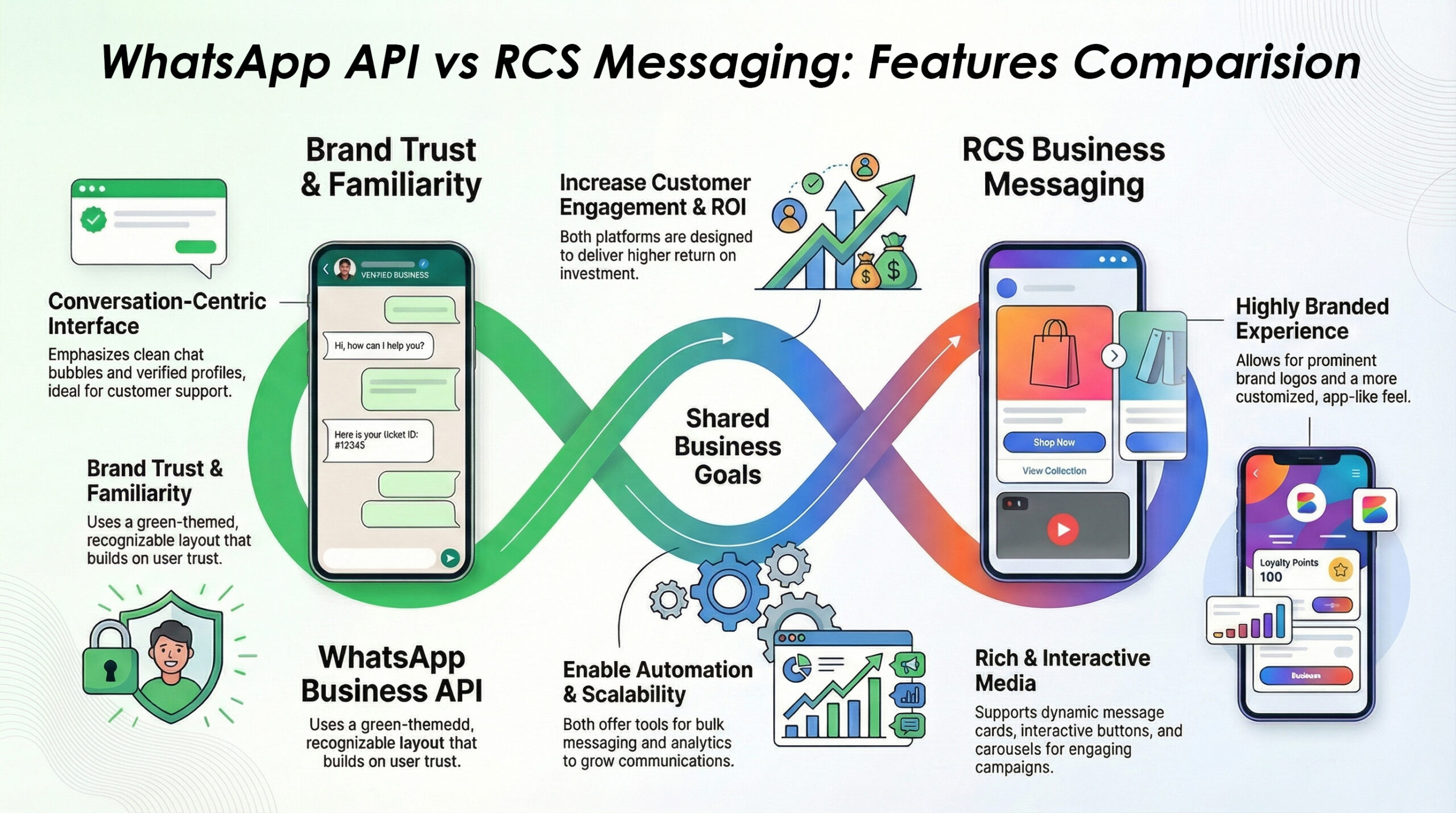
WhatsApp Business API vs RCS Business Messaging
Comprehensive feature comparison for business communication
| Feature | WhatsApp Business API | RCS Business Messaging |
|---|---|---|
| Platform Type | Works inside the WhatsApp application | Works inside the phone's native messaging app |
| Device & OS Support | Android & iOS (WhatsApp app required) | Android (Google Messages) and iOS (Apple Messages from iOS 18), carrier dependent |
| App Installation Required | Yes | No |
| Internet Dependency | Requires active internet connection | Requires active internet connection |
| User Reach in India | Very high due to WhatsApp penetration | Rapidly growing with telecom support |
| Message Types | Text, images, videos, documents, buttons | Rich cards, images, videos, carousels, quick replies, CTA buttons |
| Interactivity Level | High (best for 1-to-1 conversations) | Very high (designed for rich engagement) |
| Template Requirement | Mandatory for business-initiated messages | Not mandatory for most campaigns |
| Bulk Messaging | Limited and expensive at scale | Highly suitable for bulk campaigns at low cost |
| Brand Visibility | Business profile, optional green tick | Brand name, logo, and verified sender displayed |
| Automation & API | API & chatbot supported | API & chatbot supported |
| Analytics & Insights | Delivery and read receipts | Delivery, reads, clicks, and user interactions |
| Pricing Model | Conversation-based pricing | Per-message pricing |
| Cost Efficiency | Higher for marketing campaigns | More cost-effective for large-scale messaging |
| Best Use Cases | Customer support, sales, conversations | Promotions, alerts, reminders, notifications |
| Scalability | Moderate | High |
Choose the right platform for your business needs